Issue: EXTROPY #5 · Winter 1990
Author: Dr. John Hospers & Tom W. Bell
Pages: 6–8 · 3 scanned pages
Forum: Art and Communication (with reply)
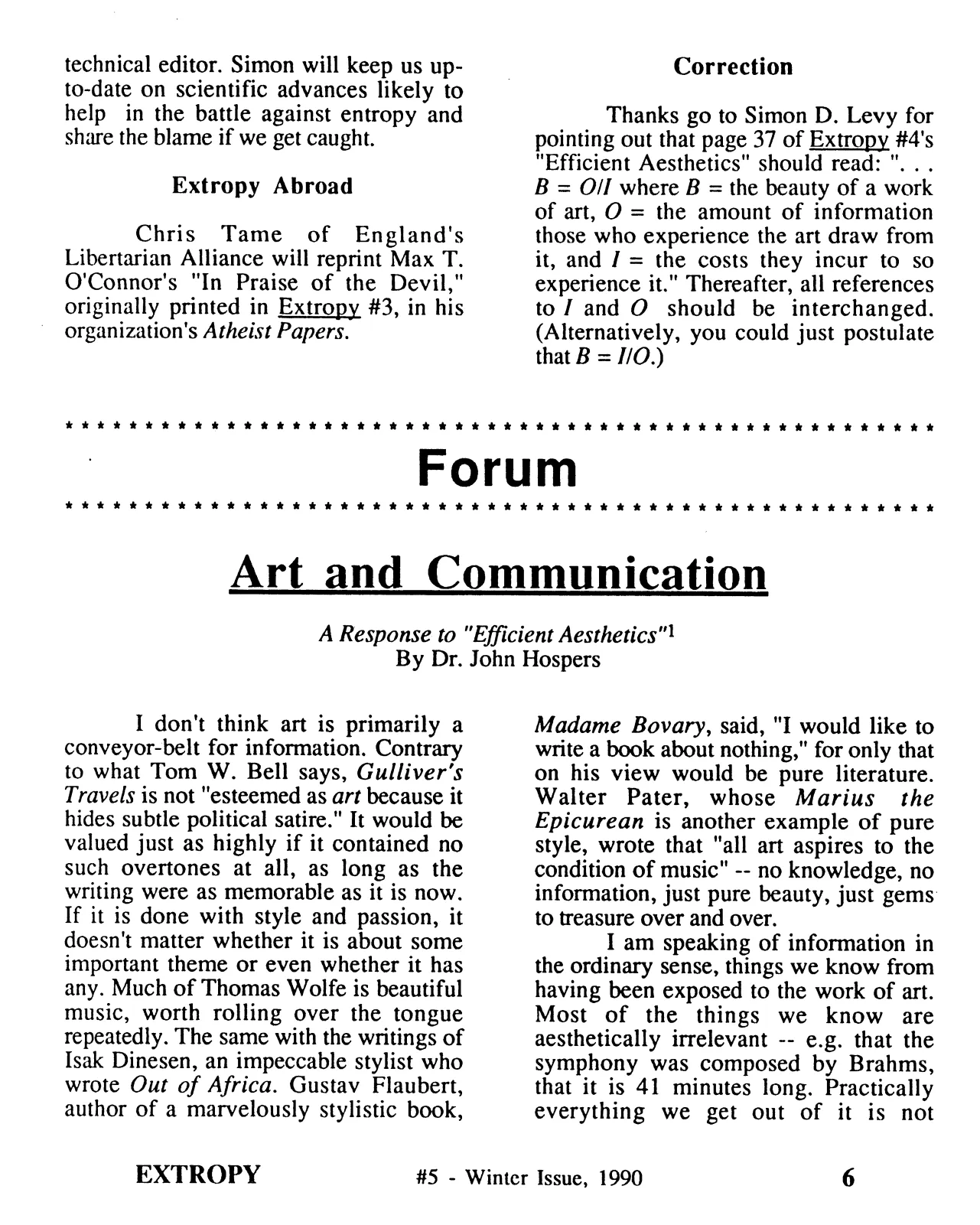
technical editor. Simon will keep us up-to-date on scientific advances likely to help in the battle against entropy and share the blame if we get caught.
Extropy Abroad
Chris Tame of England’s Libertarian Alliance will reprint Max T. O’Connor’s ‘In Praise of the Devil,’ originally printed in Extropy #3, in his organization’s Atheist Papers.
Correction
Thanks go to Simon D. Levy for pointing out that page 37 of Extropy #4’s ‘Efficient Aesthetics’ should read: ’… $B = O/I$ where B = the beauty of a work of art, O = the amount of information those who experience the art draw from it, and I = the costs they incur to so experience it.’ Thereafter, all references to I and O should be interchanged. (Alternatively, you could just postulate that $B = I/O$.)
Forum
Art and Communication
*A Response to ‘Efficient Aesthetics’*¹
I don’t think art is primarily a conveyor-belt for information. Contrary to what Tom W. Bell says, Gulliver’s Travels is not ‘esteemed as art because it hides subtle political satire.’ It would be valued just as highly if it contained no such overtones at all, as long as the writing were as memorable as it is now. If it is done with style and passion, it doesn’t matter whether it is about some important theme or even whether it has any. Much of Thomas Wolfe is beautiful music, worth rolling over the tongue repeatedly. The same with the writings of Isak Dinesen, an impeccable stylist who wrote Out of Africa. Gustav Flaubert, author of a marvelously stylistic book,
Madame Bovary, said, ‘I would like to write a book about nothing,’ for only that on his view would be pure literature. Walter Pater, whose Marius the Epicurean is another example of pure style, wrote that ‘all art aspires to the condition of music’ — no knowledge, no information, just pure beauty, just gems to treasure over and over.
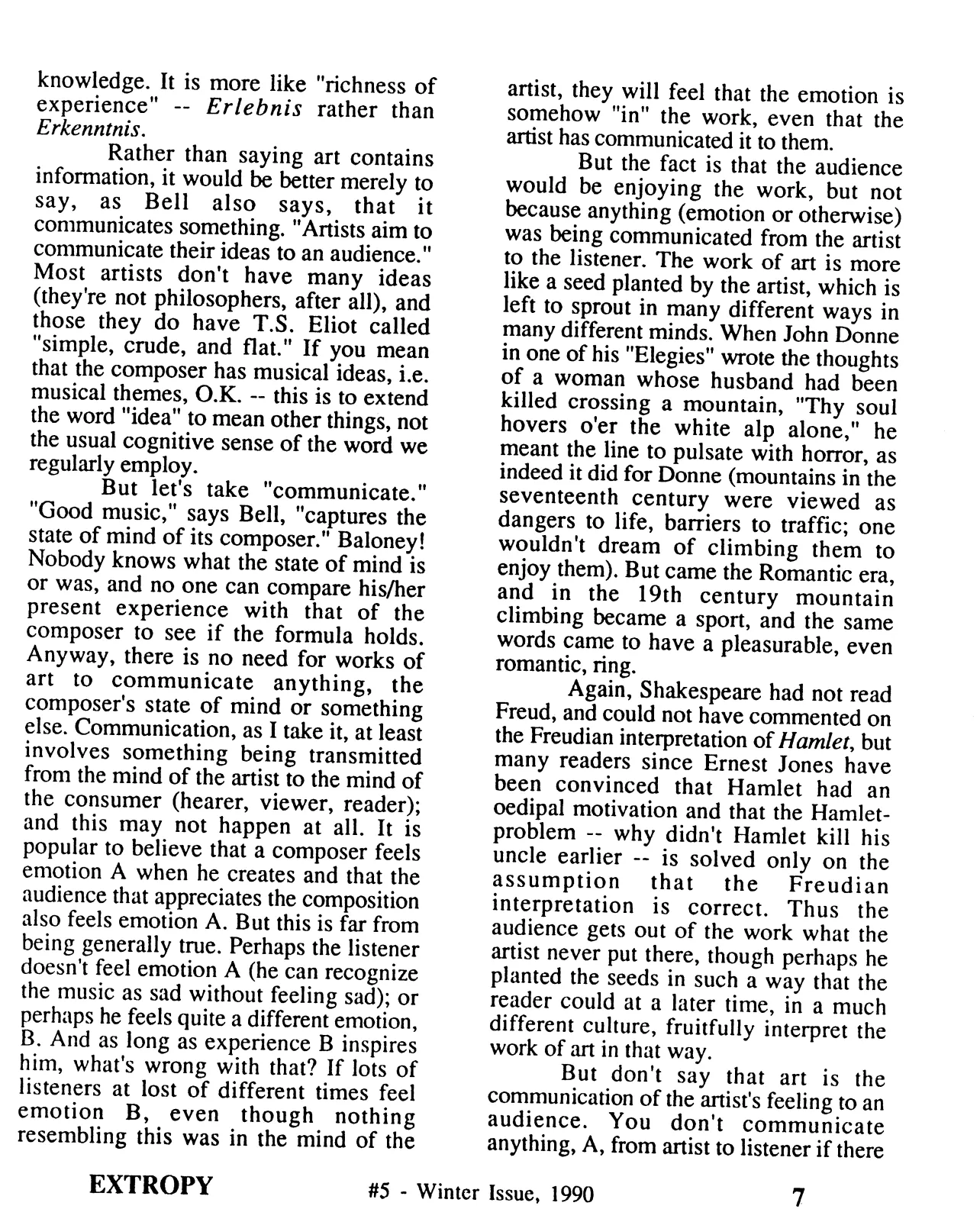
I am speaking of information in the ordinary sense, things we know from having been exposed to the work of art. Most of the things we know are aesthetically irrelevant — e.g. that the symphony was composed by Brahms, that it is 41 minutes long. Practically everything we get out of it is not knowledge. It is more like ‘richness of experience’ — Erlebnis rather than Erkenntnis.
Rather than saying art contains information, it would be better merely to say, as Bell also says, that it communicates something. ‘Artists aim to communicate their ideas to an audience.’ Most artists don’t have many ideas (they’re not philosophers, after all), and those they do have T.S. Eliot called ‘simple, crude, and flat.’ If you mean that the composer has musical ideas, i.e. musical themes, O.K. — this is to extend the word ‘idea’ to mean other things, not the usual cognitive sense of the word we regularly employ.
But let’s take ‘communicate.’ ‘Good music,’ says Bell, ‘captures the state of mind of its composer.’ Baloney! Nobody knows what the state of mind is or was, and no one can compare his/her present experience with that of the composer to see if the formula holds. Anyway, there is no need for works of art to communicate anything, the composer’s state of mind or something else. Communication, as I take it, at least involves something being transmitted from the mind of the artist to the mind of the consumer (hearer, viewer, reader); and this may not happen at all. It is popular to believe that a composer feels emotion A when he creates and that the audience that appreciates the composition also feels emotion A. But this is far from being generally true. Perhaps the listener doesn’t feel emotion A (he can recognize the music as sad without feeling sad); or perhaps he feels quite a different emotion, B. And as long as experience B inspires him, what’s wrong with that? If lots of listeners at lost of different times feel emotion B, even though nothing resembling this was in the mind of the artist, they will feel that the emotion is somehow ‘in’ the work, even that the artist has communicated it to them.
But the fact is that the audience would be enjoying the work, but not because anything (emotion or otherwise) was being communicated from the artist to the listener. The work of art is more like a seed planted by the artist, which is left to sprout in many different ways in many different minds. When John Donne in one of his ‘Elegies’ wrote the thoughts of a woman whose husband had been killed crossing a mountain, ‘Thy soul hovers o’er the white alp alone,’ he meant the line to pulsate with horror, as indeed it did for Donne (mountains in the seventeenth century were viewed as dangers to life, barriers to traffic; one wouldn’t dream of climbing them to enjoy them). But came the Romantic era, and in the 19th century mountain climbing became a sport, and the same words came to have a pleasurable, even romantic, ring.
Again, Shakespeare had not read Freud, and could not have commented on the Freudian interpretation of Hamlet, but many readers since Ernest Jones have been convinced that Hamlet had an oedipal motivation and that the Hamlet-problem — why didn’t Hamlet kill his uncle earlier — is solved only on the assumption that the Freudian interpretation is correct. Thus the audience gets out of the work what the artist never put there, though perhaps he planted the seeds in such a way that the reader could at a later time, in a much different culture, fruitfully interpret the work of art in that way.
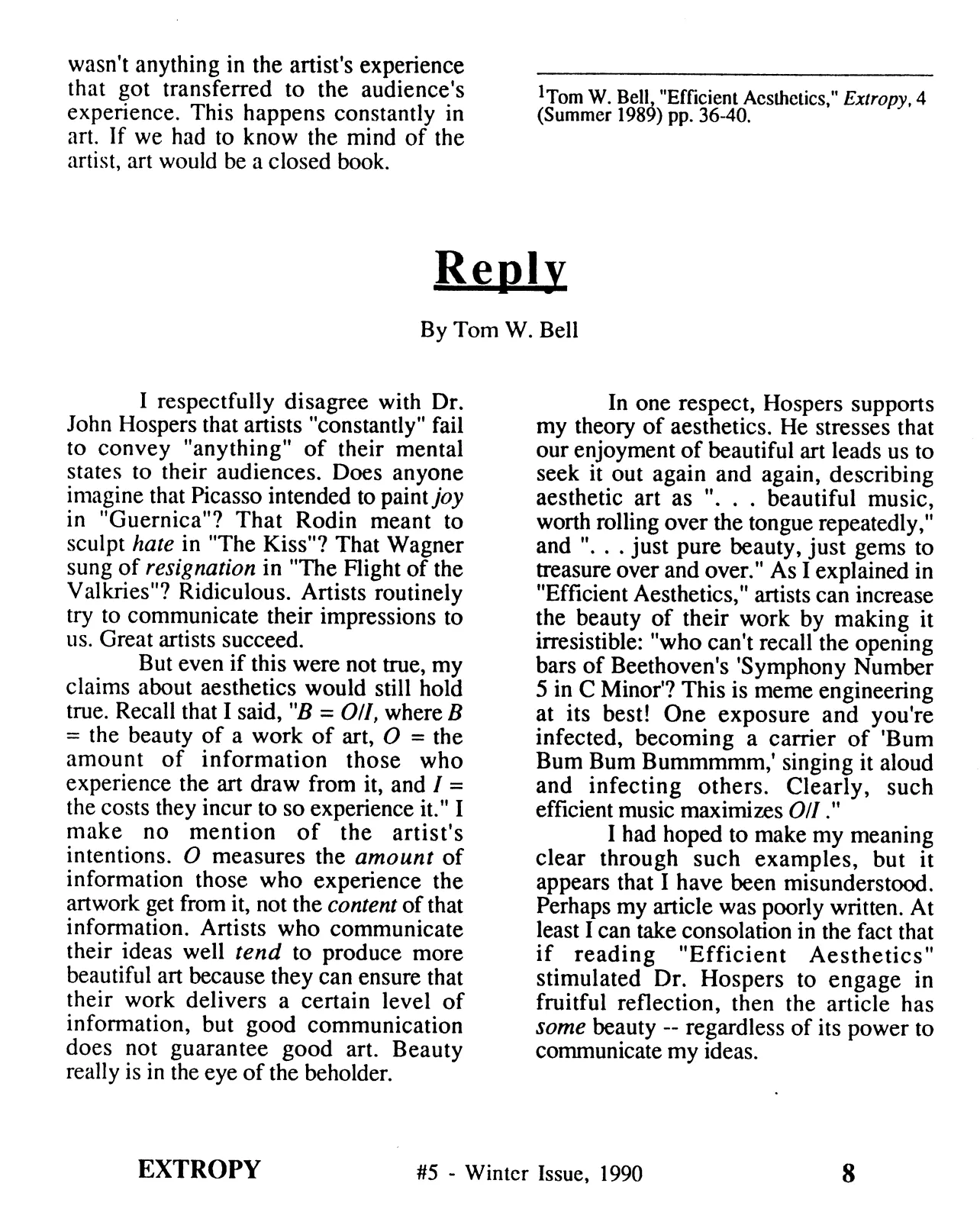
But don’t say that art is the communication of the artist’s feeling to an audience. You don’t communicate anything, A, from artist to listener if there wasn’t anything in the artist’s experience that got transferred to the audience’s experience. This happens constantly in art. If we had to know the mind of the artist, art would be a closed book.
¹Tom W. Bell, “Efficient Aesthetics,” Extropy, 4 (Summer 1989) pp. 36-40.
Reply
By Tom W. Bell
I respectfully disagree with Dr. John Hospers that artists “constantly” fail to convey “anything” of their mental states to their audiences. Does anyone imagine that Picasso intended to paint joy in “Guernica”? That Rodin meant to sculpt hate in “The Kiss”? That Wagner sung of resignation in “The Flight of the Valkries”? Ridiculous. Artists routinely try to communicate their impressions to us. Great artists succeed.
But even if this were not true, my claims about aesthetics would still hold true. Recall that I said, “B = O/I, where B = the beauty of a work of art, O = the amount of information those who experience the art draw from it, and I = the costs they incur to so experience it.” I make no mention of the artist’s intentions. O measures the amount of information those who experience the artwork get from it, not the content of that information. Artists who communicate their ideas well tend to produce more beautiful art because they can ensure that their work delivers a certain level of information, but good communication does not guarantee good art. Beauty really is in the eye of the beholder.
In one respect, Hospers supports my theory of aesthetics. He stresses that our enjoyment of beautiful art leads us to seek it out again and again, describing aesthetic art as ”… beautiful music, worth rolling over the tongue repeatedly,” and ”… just pure beauty, just gems to treasure over and over.” As I explained in “Efficient Aesthetics,” artists can increase the beauty of their work by making it irresistible: “who can’t recall the opening bars of Beethoven’s ‘Symphony Number 5 in C Minor’? This is meme engineering at its best! One exposure and you’re infected, becoming a carrier of ‘Bum Bum Bum Bummmmm,’ singing it aloud and infecting others. Clearly, such efficient music maximizes O/I.”
I had hoped to make my meaning clear through such examples, but it appears that I have been misunderstood. Perhaps my article was poorly written. At least I can take consolation in the fact that if reading “Efficient Aesthetics” stimulated Dr. Hospers to engage in fruitful reflection, then the article has some beauty — regardless of its power to communicate my ideas.
VIEW ORIGINAL SCAN (3 pages)