Issue: EXTROPY #5 · Winter 1990
Author: A.
Pages: 11–19 · 9 scanned pages
Arch-anarchy
Arch-anarchy¹
By A
A Call to Arms
Down with the law of gravity!
By what right does it counter my will? I have not pledged my allegiance to the law of gravity; I have learned to live under its force as one learns to live under a tyrant. Whatever gravity’s benefits, I want the freedom to deny its iron hand. Yet gravity reigns despite my complaints. ‘No gravitation without representation!’ I shout. ‘Down with the law of gravity!’
Down with all of nature’s laws!
Gravity, the electromagnetic force, the strong and weak nuclear forces — together they conspire to destroy human intelligence. Their evil leader? Entropy. Throw out the Four Forces! Down with Entropy!
Down with every limitation!
I call for the highest of all freedoms. Come, let us cast off all chains! We will make our own heaven. We will become our own gods.
I call for perfect self-rule; I call for arch-anarchy!
What is Arch-anarchy?
Arch-anarchy is the highest form of anarchy.² Plain anarchists deny the validity of the State’s laws. But why stop there? As an arch-anarchist, I deny the validity of every law — human or otherwise — that gets in the way of my will.
Anarchism comes in many flavors, but eventually they all boil down to arch-anarchy.³ Arch-anarchy follows directly from individualist anarchism, the sort of anarchism that places the individual will before the commands of statists.⁴ All other forms of anarchism in turn reduce to individualist anarchism. Why? Because individuals make choices, not groups. So whatever form of society an anarchist proposes, he must convince other individuals to accept it. If he fails and tries to force his version of utopia on them, he becomes just another statist. All anarchists must face up to this fact; individualist anarchists not only admit it, they embrace it. And as I will demonstrate, once you admit the supremacy of the individual will you must move on to arch-anarchy. Why accept anything less?
Reality Explained
As an arch-anarchist, I divide the universe into two opposing forces: my will and obstacles to my will. And I have one goal in life: that the former shall overcome the latter.
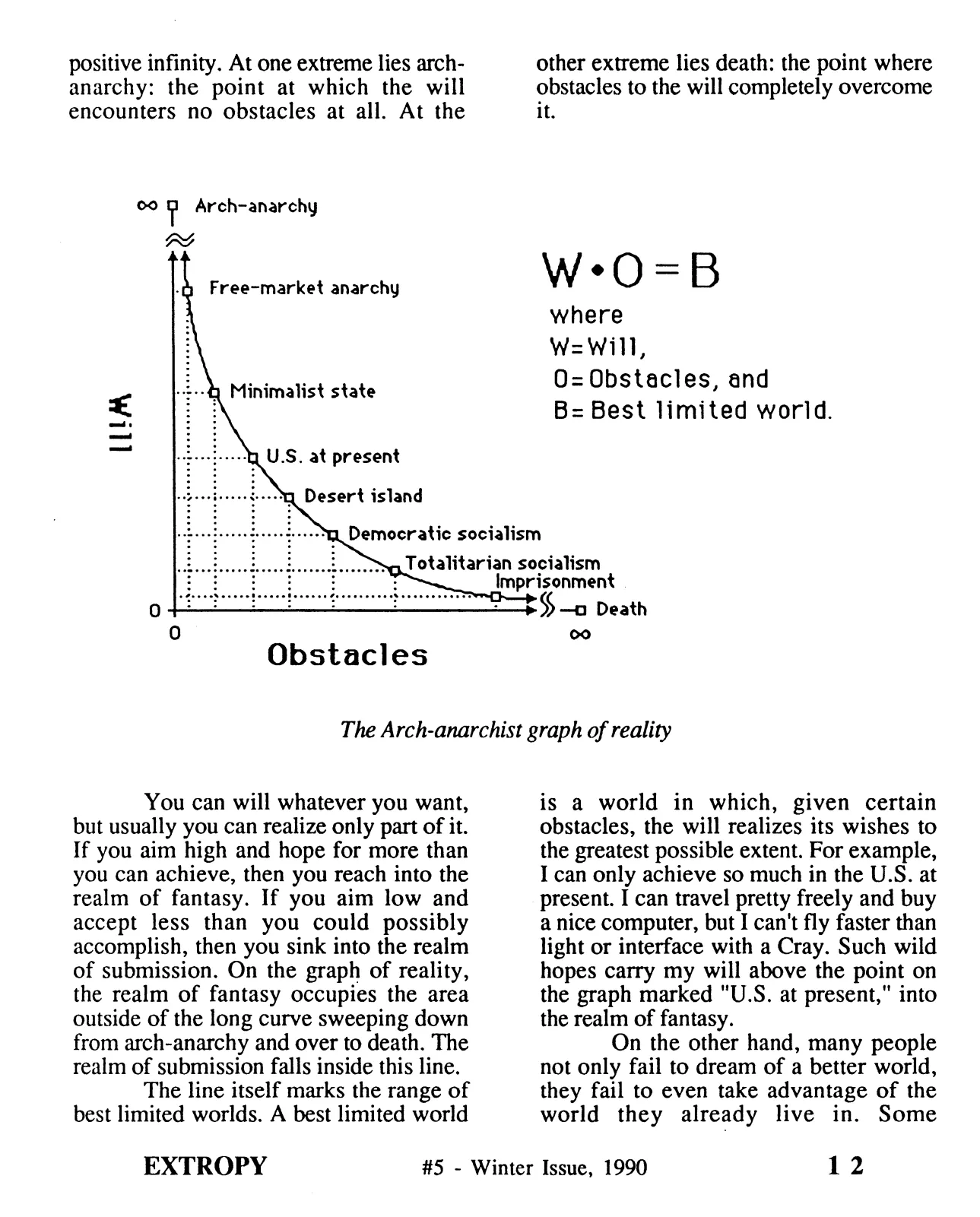
The graph below sums up this world-view neatly. Axes charting the will and its obstacles cross at right angles. Because one can will nothing or everything, and because one can face no obstacles or countless obstacles, the values of these two axes run from zero to
1 1 positive infinity. At one extreme lies arch-anarchy: the point at which the will encounters no obstacles at all. At the other extreme lies death: the point where obstacles to the will completely overcome it.
The Arch-anarchist graph of reality
You can will whatever you want, but usually you can realize only part of it. If you aim high and hope for more than you can achieve, then you reach into the realm of fantasy. If you aim low and accept less than you could possibly accomplish, then you sink into the realm of submission. On the graph of reality, the realm of fantasy occupies the area outside of the long curve sweeping down from arch-anarchy and over to death. The realm of submission falls inside this line.
The line itself marks the range of best limited worlds. A best limited world is a world in which, given certain obstacles, the will realizes its wishes to the greatest possible extent. For example, I can only achieve so much in the U.S. at present. I can travel pretty freely and buy a nice computer, but I can’t fly faster than light or interface with a Cray. Such wild hopes carry my will above the point on the graph marked ‘U.S. at present,’ into the realm of fantasy.
On the other hand, many people not only fail to dream of a better world, they fail to even take advantage of the world they already live in. Some
1 2 unquestionably accept outmoded beliefs. Some hide in their rooms. Some commit suicide. All of these people fall below the curve of best possible worlds into the realm of submission.
Personally, I like to push the limits of the possible, so I live right on the curve of best limited worlds.
Where are you on the graph of reality?
Why Fight It?
More importantly, where do you want to be?
I want to escape the U.S. at present, pass through minimal statism, and soar beyond even anarcho-capitalism. I want the perfect and absolute freedom of arch-anarchy. I want to become a god.
I welcome you to come along. Regardless of all my talk about wanting what I will, I want the same thing for my friends. When I talk about my self-interest, I do not mean only the interests of this particular body and brain. I am no more than a particular pattern of information, a set of data and processing rules. To the extent that I share this pattern with others, we share personal identities.
Given the advantages of my subjective point of view, it is almost always in my self-interest to preserve my body and brain.⁵ But if I were forced to choose between the preservation of the information now stored in my brain and that in the brains of all of my immortalist, libertarian, extropian friends, I would best serve ‘my’ (our) self-interest by saving ‘them’ (us). So although I speak of my will, I use the term broadly. Should others ever join me in my quest for arch-anarchy, I will not fight with them over the spoils of heaven; there ought to be plenty of bliss to go around. Rather, I will embrace them as my kin, for all arch-anarchists share the love of life and the thirst for freedom.
But if you don’t want to join me in utopia, that’s your business. If godhood doesn’t appeal to you, then you aren’t much like me anyhow and it probably isn’t in my self-interest to drag you into heaven. Perfect freedom is not an objective Good that every moral being must crave.⁶ There are no objective moral values. There is only the will and its obstacles. If you give in to entropy you won’t be Wrong — you’ll be Dead.
Because I speak only of freeing my will from all obstacles, political theorists might decry my mixing negative and positive freedoms. I do recognize the distinction, however. I agree with libertarians that so long as we remain political animals, we should only seek freedom from others’ coercion — not freedom to others’ property. Notice the caveat, though: so long as we remain political animals. We currently live in a Hobbesian world of scarce goods, conflicting ends, and mutual threats. We libertarians mutually agree to enforce only negative rights because they give us the best limited world at present.
This could change, however. Technology may bring us unlimited goods, or we may find the means to merge our personalities into one being seeking one end, or we may devise a defense effective against all personal threats. If so, we could give up the distinction between negative and positive freedoms and get back to the reason we favored one over the other in the first place: to maximize freedom qua freedom.
1 3
Know Your Enemy
‘Ok, I’m convinced that I should try to free my will from all obstacles,’ you might say. ‘But how can we possibly overthrow the laws of nature? Aren’t they beyond all human control?’
We arch-anarchists wage a war against everything that stands between us and godhood. Let us therefore heed Sun Tzu’s advice: Know your enemy. A critical scrutiny of natural laws shows that they have far less power than people typically assume.
People often idolize natural laws as immutable dictates that order the universe and set the ultimate limits of human ambition. This view is particularly popular among those who cannot stomach religion, yet who still secretly hunger for some sort of God. By worshiping the laws of nature, they can surrender their wills without embarrassing themselves in front of their scientifically correct peers.7
Perhaps such people confuse natural laws with statists’ laws. We break statist laws only at the risk of suffering at the hands of those who claim to act in the name of the State. But natural laws are not the laws in the conventional sense of word. No legislature wrote them, no executive enforces them, and no judiciary interprets them. We need not fear that if we break a natural law we will suffer the wrath of the ‘state of nature.’
So what are natural laws? No more than observed constants. They tell us not how the universe must behave, but only how it has been observed to behave by certain scientists in certain labs at certain times under certain conditions. We have absolutely no guarantee that the rules will not change tomorrow. We have only faith.
But faith is not enough. The laws of nature are weaker than people usually suppose. Astronomers once thought that the sun circled the earth in accord with the laws of nature. They were wrong. Physicists used to think that objects burned thanks to phlogiston. They were wrong, too. Chemists claimed that atoms were indivisible. Wrong again. Given the track record of science to date, it doesn’t take a radical empiricist to suspect the durability of what we currently take to be the laws of nature.
Even if we had complete confidence in our scientists, the laws of nature would fail to inspire much confidence. According to the classical theory of general relativity, the universe occupied a point of infinite density and infinite space-time curvature at the start of its ‘big bang.’ It will return to this condition should it undergo a ‘big crunch.’ As Stephan Hawkings notes, ‘All the known laws of science would break down at such a point.‘8
All these points demonstrate that the laws of nature fail to merit our awe. They are not inviolable edicts from God. They are only statistical generalizations about recent scientific observations. We have broken natural laws before and we can break them again.9 The important point is to want to control the laws of nature. The rest is mere technical details. Where there’s a will… .10
Taking Arch-anarchy to its Illogical Extreme
Control of the laws of nature would give us the power to fly in defiance of gravity, live forever, and create our own universes. We would become gods. But that’s not enough.
1 4
Mastery of the laws of nature won’t enable me to realize everything I will, for I want to become more than a mere god. I want to become God, omniscient and omnipotent.¹¹
This poses a problem, however: an omniscient God knows everything, including the course of Its own will; an omnipotent God can do anything, including changing Its mind. Omniscience and omnipotence thus contradict one another. Traditionally, theologians have saved face by claiming that God transcends contradiction. If that is what it takes to become a God, so be it: Down with the law of non-contradiction!
In Defense of Contradiction
Western philosophers love to kick contradiction around. They portray it as the bane of logic, the fatal flaw to any argument. Why has contradiction gotten such a bad name? The problem is that if you allow a contradiction into your train of thought then anything else follows — including the converse of what you are trying to prove.¹² Once started, contradiction spreads like wildfire, consuming all truths. Western philosophers have therefore adopted the non-contradiction principle as one of the so-called ‘laws of thought’: Not both A and not-A.¹³
But the non-contradiction principle deserves even less respect than the laws of nature. The downfall of the laws of nature will come only with technological advancements. I can disprove the the law of non-contradiction right now, however. What’s more, I will do so on western philosophy’s own terms.¹⁴
Metaphysicians have long held that no effect can be more real than its cause. Descartes, for example, explains that
… there must at least be as much reality in the efficient and total cause as in its effect. For, pray, whence can the effect derive its reality, if not from its cause? … And from this it follows, not only that something cannot proceed from nothing, but likewise that what is more perfect — that is to say, which has more reality within itself — cannot proceed from the less perfect.¹⁵
Let us compare the principles of contradiction and non-contradiction on these grounds. We can easily generate the principle of non-contradiction from the principle of contradiction.¹⁶ After all, we can generate anything from a contradiction. If we start with only the principle of non-contradiction, however, we’re stuck with it. It lacks the power to generate the contradiction principle — instead, it explicitly denies it.
Applying Descartes’s criteria, I therefore conclude that the principle of contradiction is ontologically prior to the principle of non-contradiction — i.e., rather than being impossible, contradiction is more real and more perfect than non-contradiction.
The Logical and Theological Considerations
Arch-anarchy demands the overthrow of the non-contradiction principle, for only then can the will be free of all obstacles, be they statist, moral, natural, or logical. What would such perfect freedom feel like? Like being God, for only God has the power to realize whatever It wills.
And how does Godhood feel? Theology offers proofs that God is perfect, omniscient, omnipotent, and omnipresent. From our currently limited perspectives, we find it hard to imagine possessing such great powers.¹⁷ We can, however, deduce some of God’s other traits from this list of qualities.
God is not an old Caucasian male with a long beard and a deep voice (that’s Santa Claus). God’s capacities will not fit within a human form — hence my referring to God as ‘It’, rather than ‘He’ or ‘She’. Even ‘It’ serves as inexact shorthand, however, for God transcends all forms.
Because omnipotence excludes competition, there is only one God. Hence my saying ‘God’ rather than ‘Gods’. All arch-anarchists aim at the same end, and those of us who reach it will merge into one being: God.
Because God is perfectly free, It escapes the reach of moral rules. Kant explains that morals apply only to imperfect wills, which need help overcoming weakness and ignorance. By merit of its inherent perfection, however, ‘no imperatives hold for the divine will.‘¹⁸
By now these theological considerations probably have my anti-religious readers chaffing. Note that theology need not entail religion, however. Arch-anarchists practice reliberium, not religion. ‘Religion’ comes from the Latin roots re, or ‘again’ and ligare, or ‘to bind’. Religion thus aims ‘to bind again’ to God those who have escaped the grip of the church. Arch-anarchists cannot but take offense to such an idea. We thus shun religion for ‘reliberion’ (from re plus liber), because we seek to free our wills from all the binds to which they have been subjected.
By the same token, I will gladly give up ‘God’ if you prefer less loaded terms. Do you prefer ‘The Tao’? Fine. Robert Nozick favors ‘Ein Sof’. Call it what you will, we need the ultimate end of escaping all limitations to give meaning to our lives.¹⁹ Nozick explains:
The problem of meaning is created by limits. We cope with this by, in little ways or big, transcending these limits. Yet whatever extent we thereby reach in a wider realm also has its own limits — the same problem surfaces again. This suggests that the problem can be avoided or transcended only by something without limits, only by something that cannot be stood outside of, even in imagination… something that somehow includes all possibilities, all possible universes, and excludes nothing. This something not only is not limited to some portion of actuality while excluding the rest, it also is not limited to that one portion of possibility which is (all of) actuality. It encompasses all. For this unlimited, we shall also use the Hebrew term Ein Sof (meaning without end or limit).²⁰
We now have some idea of what to expect if we succeed in achieving arch-anarchy’s goal of a will without limits. Let us finish with a harder question: Is it possible to achieve that goal? To put it another way, can God exist?
In one respect the question cannot be answered. As Nozick explains, ‘Terms demarcate things from other things, and so describe limits and boundaries. If Ein Sof was one way and also another, it would not be limited; also, it would not be describable by terms of the sort we use. The unlimited is ineffable.‘²¹ Because ‘existence’ and ‘non-existence’ are limiting terms we cannot apply them to God (or the Tao, or Ein Sof), which transcends all contradictions — including that of existence and non-existence. So when asked, ‘Can God exist?’ we must answer, ‘Yes (and no).’
But although this response may be semantically correct, if fails to satisfy those of us who seek to become God. Granted that God may both exist and not-exist; we arch-anarchists want to know whether or not we could ever become powerful enough to embody such a contradiction. As I have argued throughout this essay, nothing prevents our doing so. Neither the laws of nature nor the principle of non-contradiction block the road to God. We need only time, wisdom, and luck. To this version of the question ‘Can God exist?’ I therefore reply, ‘Why not?’
I have asked ‘Can God exist?’ — not the popular question ‘Does God exist?’ — because I do not envision God as our creator but rather as something that we will create. I note, however, that God does exist if and only if God will exist. Once we create God it will transcend the barriers of time, moving backwards through the years to exist now. God’s omnipresence runs across all dimensions. This raises the possibility that we might now worship the God that we will later become. I suspect, however, that we would be better off keeping our prayers to ourselves.
Conclusion
I have argued for the most radical form of anarchy: arch-anarchy. As an arch-anarchist, I refuse to recognize the validity of any obstacle to my will. Is this selfish? Yes, but because I take a broad view of personal identity I am willing to consider others’ interests along with my own. I therefore invite you to join me in my fight for perfect freedom. Together we will cast down the laws of statists, moralists, nature, and logic. Our ultimate goal: the singular, perfect, omnipotent power of God. Imagine the heights that we might achieve… .
We stand alone before the gates of heaven. Below us lie the smouldering husks of every law that ever blocked our way, their claims to validity consumed in arch-anarchism’s critical inferno. Only our wills and the road to Godhood have survived. Having struggled up that long road on our own feet, we do not now fall on our bellies and plead to be admitted into heaven. Instead, we storm its gates! They open to reveal an empty city, and in that city an empty castle, and in that castle an empty throne, waiting for one who dares to assume the reign of God. We bravely mount the dais of the throne, and together pass beyond the realm of words.
Notes
¹I thank Bretagne Shaffer for having inspired this article with tales of U.C. Santa Cruz’s Organization for the Abolition of Gravity. I also benefitted from Max T. O’Connor’s tolerant ear and critical eye, and from the peripatetic company I found at Dave Pizer’s 1989 Summer Cryonics retreat.
2”Anarchy” comes from the ancient Greek word anarchos, a word formed from an (= “without”) plus archos (= “ruler”). But archos also means “main” or “principle.” By tacking it onto the front of “anarchy,” we get “arch-anarchy”: the principle against principles. This contradiction suits the term well, for I take anarchism to its logical extreme and beyond, to its illogical one.
3One possible ordering of types of anarchisms ranges them the least to the most individualist, beginning with the French anarcho-syndicalists who denied even personal property and running on past Kropotkin’s communist anarchism to Bakunin’s collectivist anarchism, then to Proudon’s mutualism, ending at the individualist anarchism of Godwin and Stirner. Anarcho-capitalism like Friedman’s could fall anywhere along this spectrum, though Rothbard’s version favors the individualist end. Tolstoy’s pacifist anarchism floats somewhere off the spectrum.
4 Among individual anarchists, Max Stirner comes closest to arch-anarchy: “Away, then, with every concern that is not altogether my concern! You think at least the ‘good cause’ must be my concern? What’s good, what’s bad? Why, I myself am my concern, and I am neither good nor bad. Neither has meaning for me.” The Ego and His Own, translated by Steven T. Byington (New York: Libertarian Book Club, 1963) p. 5.
5Thus I have recently signed up with Alcor to ensure the cryogenic preservation of my brain, should my body give out.
6For a ethical system completely compatible with these views, see Tom W. Bell, “Wisdomism” Extropy No. 2 (Winter 1989) pp. 22-28.
7Voluntary submission to perceived natural laws has a long and rich history. The pre-Socratic Greek naturalists began the deceit. Aristotle continued the tradition by seeking the human good in the fulfillment of human nature. The Stoics saw natural law as an expression of God’s will. St. Aquinas grafted Christian doctrines directly onto the framework of Aristotle’s moral philosophy. Spinoza went so far as to equate nature with God. This theological approach to natural law lingers on in modern science.
All of these doctrines make the mistake of submitting the will to the dictates of nature, but some are worse than others. If technology cannot provide any outs, Aristotle offers realistic advice on moral self-management and Stoicism provides cold comforts. But when the deification of nature goes too far it can render great minds weak. Witness how Einstein’s doctrine that “God does not play dice with the universe” shut him out of the quantum revolution.
8Stephan W. Hawking, A Brief History of Time (New York: Bantam Books, 1988) p. 133.
9”Japanese scientists have reported that small gyroscopes lose weight when spun under certain conditions, apparently in defiance of gravity… . If substantiated by further tests, the finding could have a profound influence on physics and the study of the universe, and perhaps in the making of practical anti-gravity devices.” The Kansas City Times, Thursday December 28, 1989, C-10. The results of the two scientists, Hideo Hayasaka and Sakae Takeuchi of Tohoku University, were originally reported in the December 18 issue of Physical Review Letters.
10In “Fragment of Nature” Goethe claimed that “The most unnatural also is nature… even in resisting her laws one obeys them; and one works with her even in desiring to work against her.” Following Goethe, skeptics might claim that because the laws of nature describe phenomena, rather than dictate it, one can never violate them. To put it another way, one never breaks a law of nature; one merely creates a new law.
But I want to realize whatever I will, even if each new act breaks all previous laws of nature. It stretches the meaning of the word “law” beyond recognition to claim that under such circumstances I still follow the laws of nature. In any case, the Goethe objection concerns mere semantics. And so long as I can do what I please, I don’t care what others call it.
11Strictly speaking, I am only after omnipotence. Omniscience quickly follows, however, if we consider knowledge as power. And in any case, omnipotence alone generates contradiction. God could, for example, bring together an unstoppable force and an immovable object.
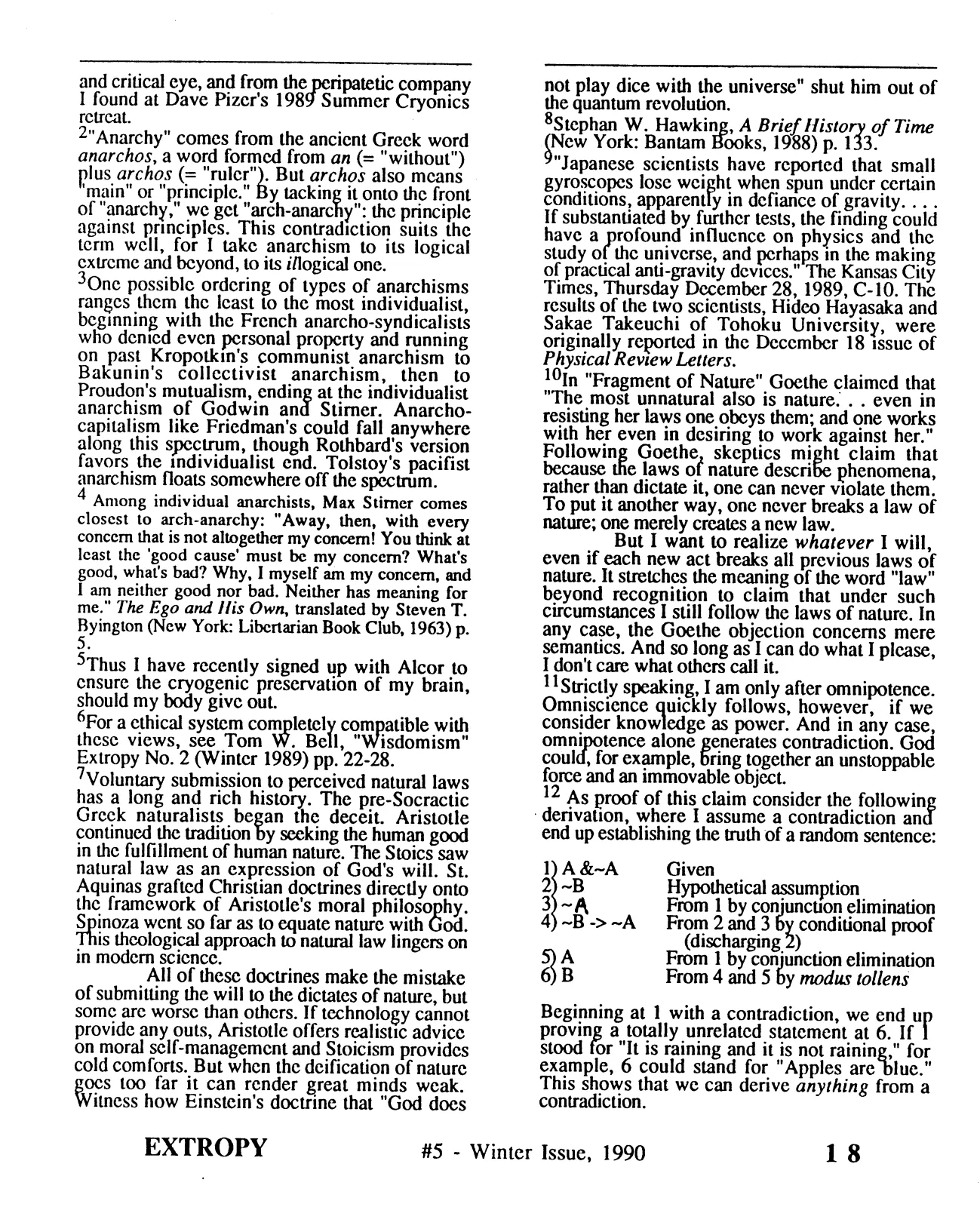
12 As proof of this claim consider the following derivation, where I assume a contradiction and end up establishing the truth of a random sentence:
- A & ~A Given
- ~B Hypothetical assumption
- ~A From 1 by conjunction elimination
- ~B -> ~A From 2 and 3 by conditional proof (discharging 2)
- A From 1 by conjunction elimination
- B From 4 and 5 by modus tollens
Beginning at 1 with a contradiction, we end up proving a totally unrelated statement at 6. If 1 stood for “It is raining and it is not raining,” for example, 6 could stand for “Apples are blue.” This shows that we can derive anything from a contradiction.
1 8
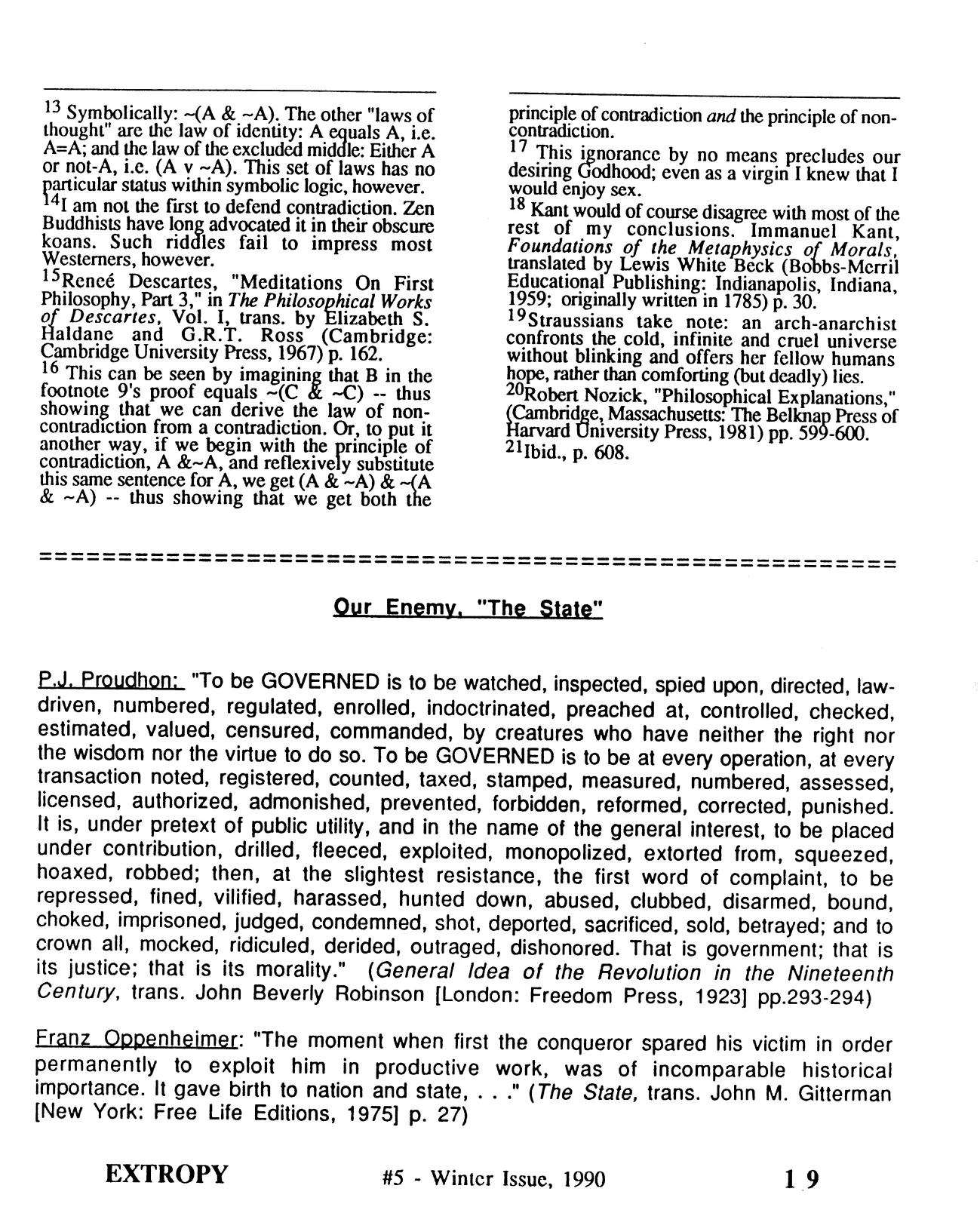
¹³ Symbolically: ~(A & ~A). The other ‘laws of thought’ are the law of identity: A equals A, i.e. A=A; and the law of the excluded middle: Either A or not-A, i.e. (A v ~A). This set of laws has no particular status within symbolic logic, however.
¹⁴I am not the first to defend contradiction. Zen Buddhists have long advocated it in their obscure koans. Such riddles fail to impress most Westerners, however.
¹⁵Renée Descartes, ‘Meditations On First Philosophy, Part 3,’ in The Philosophical Works of Descartes, Vol. I, trans. by Elizabeth S. Haldane and G.R.T. Ross (Cambridge: Cambridge University Press, 1967) p. 162.
¹⁶ This can be seen by imagining that B in the footnote 9’s proof equals ~(C & ~C) — thus showing that we can derive the law of non-contradiction from a contradiction. Or, to put it another way, if we begin with the principle of contradiction, A &~A, and reflexively substitute this same sentence for A, we get (A & ~A) & ~(A & ~A) — thus showing that we get both the principle of contradiction and the principle of non-contradiction.
¹⁷ This ignorance by no means precludes our desiring Godhood; even as a virgin I knew that I would enjoy sex.
¹⁸ Kant would of course disagree with most of the rest of my conclusions. Immanuel Kant, Foundations of the Metaphysics of Morals, translated by Lewis White Beck (Bobbs-Merrill Educational Publishing: Indianapolis, Indiana, 1959; originally written in 1785) p. 30.
¹⁹Straussians take note: an arch-anarchist confronts the cold, infinite and cruel universe without blinking and offers her fellow humans hope, rather than comforting (but deadly) lies.
²⁰Robert Nozick, ‘Philosophical Explanations,’ (Cambridge, Massachusetts: The Belknap Press of Harvard University Press, 1981) pp. 599-600.
²¹Ibid., p. 608.
Our Enemy, ‘The State’
P.J. Proudhon: ‘To be GOVERNED is to be watched, inspected, spied upon, directed, law-driven, numbered, regulated, enrolled, indoctrinated, preached at, controlled, checked, estimated, valued, censured, commanded, by creatures who have neither the right nor the wisdom nor the virtue to do so. To be GOVERNED is to be at every operation, at every transaction noted, registered, counted, taxed, stamped, measured, numbered, assessed, licensed, authorized, admonished, prevented, forbidden, reformed, corrected, punished. It is, under pretext of public utility, and in the name of the general interest, to be placed under contribution, drilled, fleeced, exploited, monopolized, extorted from, squeezed, hoaxed, robbed; then, at the slightest resistance, the first word of complaint, to be repressed, fined, vilified, harassed, hunted down, abused, clubbed, disarmed, bound, choked, imprisoned, judged, condemned, shot, deported, sacrificed, sold, betrayed; and to crown all, mocked, ridiculed, derided, outraged, dishonored. That is government; that is its justice; that is its morality.’ (General Idea of the Revolution in the Nineteenth Century, trans. John Beverly Robinson [London: Freedom Press, 1923] pp.293-294)
Franz Oppenheimer: ‘The moment when first the conqueror spared his victim in order permanently to exploit him in productive work, was of incomparable historical importance. It gave birth to nation and state, …’ (The State, trans. John M. Gitterman [New York: Free Life Editions, 1975] p. 27)
VIEW ORIGINAL SCAN (9 pages)