Issue: EXTROPY #4 · Summer 1989
Author: Tom W. Bell
Pages: 3–5 · 3 scanned pages
Editorial: Pomp and Mitigating Circumstances
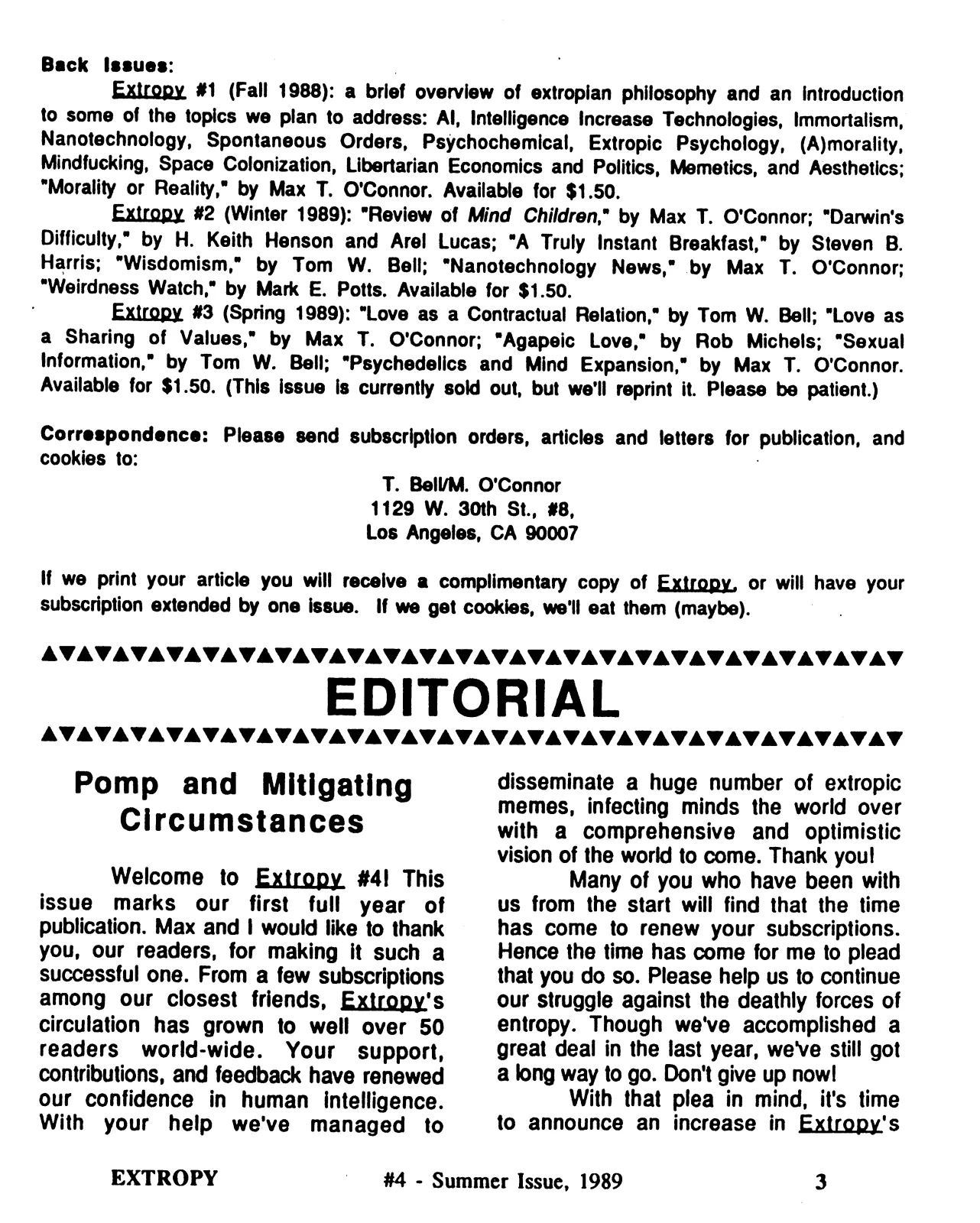
Back Issues:
Correspondence: Please send subscription orders, articles and letters for publication, and cookies to:
T. Bell/M. O’Connor
1129 W. 30th St., #8,
Los Angeles, CA 90007
If we print your article you will receive a complimentary copy of Extropy, or will have your subscription extended by one issue. If we get cookies, we’ll eat them (maybe).
EDITORIAL
Pomp and Mitigating Circumstances
Welcome to Extropy #4! This issue marks our first full year of publication. Max and I would like to thank you, our readers, for making it such a successful one. From a few subscriptions among our closest friends, Extropy’s circulation has grown to well over 50 readers world-wide. Your support, contributions, and feedback have renewed our confidence in human intelligence. With your help we’ve managed to disseminate a huge number of extropic memes, infecting minds the world over with a comprehensive and optimistic vision of the world to come. Thank you!
Many of you who have been with us from the start will find that the time has come to renew your subscriptions. Hence the time has come for me to plead that you do so. Please help us to continue our struggle against the deathly forces of entropy. Though we’ve accomplished a great deal in the last year, we’ve still got a long way to go. Don’t give up now!
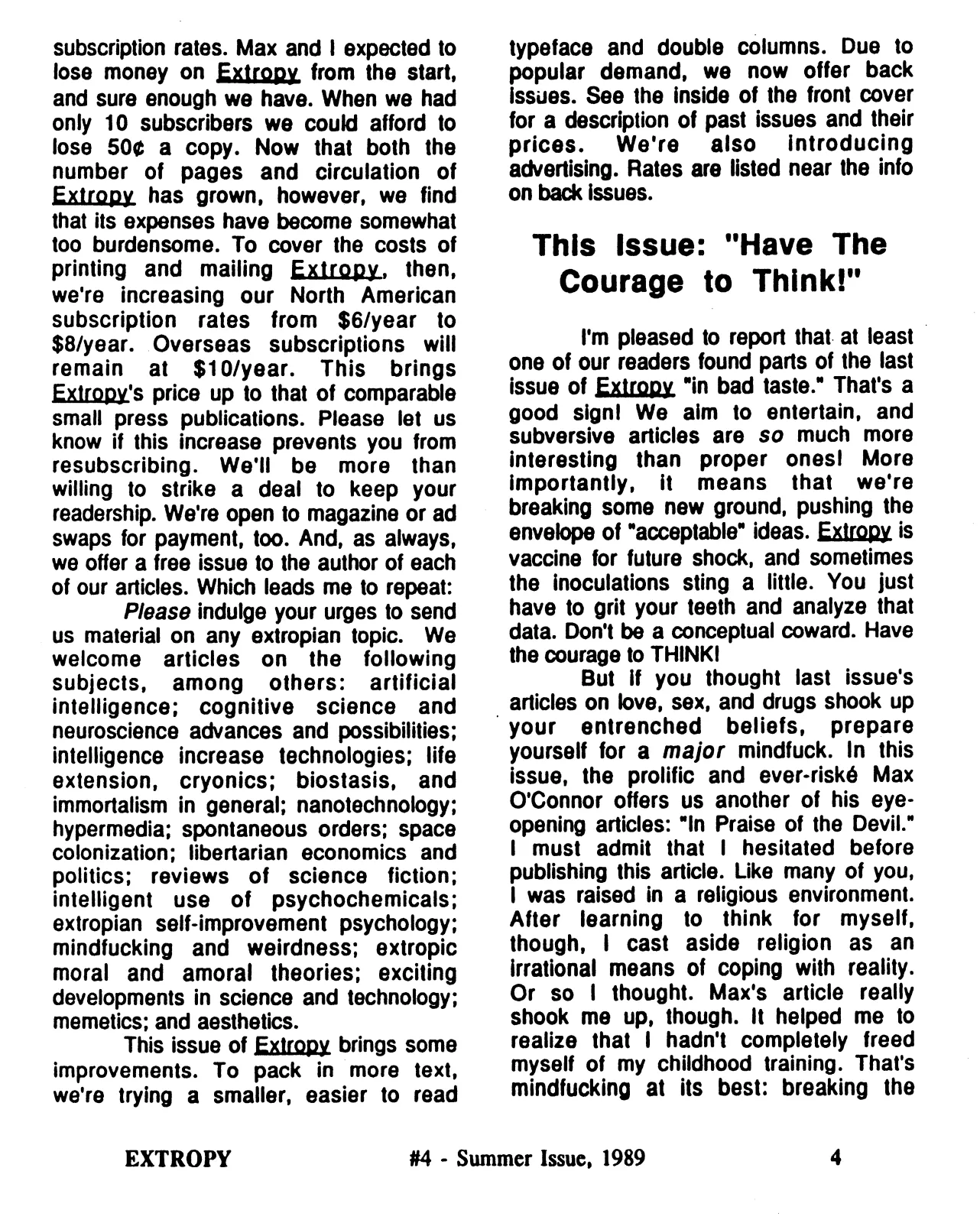
With that plea in mind, it’s time to announce an increase in Extropy’s subscription rates. Max and I expected to lose money on Extropy from the start, and sure enough we have. When we had only 10 subscribers we could afford to lose 50¢ a copy. Now that both the number of pages and circulation of Extropy has grown, however, we find that its expenses have become somewhat too burdensome. To cover the costs of printing and mailing Extropy, then, we’re increasing our North American subscription rates from $6/year to $8/year. Overseas subscriptions will remain at $10/year. This brings Extropy’s price up to that of comparable small press publications. Please let us know if this increase prevents you from resubscribing. We’ll be more than willing to strike a deal to keep your readership. We’re open to magazine or ad swaps for payment, too. And, as always, we offer a free issue to the author of each of our articles. Which leads me to repeat:
Please indulge your urges to send us material on any extropian topic. We welcome articles on the following subjects, among others: artificial intelligence; cognitive science and neuroscience advances and possibilities; intelligence increase technologies; life extension, cryonics; biostasis, and immortalism in general; nanotechnology; hypermedia; spontaneous orders; space colonization; libertarian economics and politics; reviews of science fiction; intelligent use of psychochemicals; extropian self-improvement psychology; mindfucking and weirdness; extropic moral and amoral theories; exciting developments in science and technology; memetics; and aesthetics.
This issue of Extropy brings some improvements. To pack in more text, we’re trying a smaller, easier to read typeface and double columns. Due to popular demand, we now offer back issues. See the inside of the front cover for a description of past issues and their prices. We’re also introducing advertising. Rates are listed near the info on back issues.
This Issue: ‘Have The Courage to Think!’
I’m pleased to report that at least one of our readers found parts of the last issue of Extropy ‘in bad taste.’ That’s a good sign! We aim to entertain, and subversive articles are so much more interesting than proper ones! More importantly, it means that we’re breaking some new ground, pushing the envelope of ‘acceptable’ ideas. Extropy is vaccine for future shock, and sometimes the inoculations sting a little. You just have to grit your teeth and analyze that data. Don’t be a conceptual coward. Have the courage to THINK!
But if you thought last issue’s articles on love, sex, and drugs shook up your entrenched beliefs, prepare yourself for a major mindfuck. In this issue, the prolific and ever-riske Max O’Connor offers us another of his eye-opening articles: ‘In Praise of the Devil.’ I must admit that I hesitated before publishing this article. Like many of you, I was raised in a religious environment. After learning to think for myself, though, I cast aside religion as an irrational means of coping with reality. Or so I thought. Max’s article really shook me up, though. It helped me to realize that I hadn’t completely freed myself of my childhood training. That’s mindfucking at its best: breaking the chains of entropic conceptual structures. So I not only forced myself to print it, I also drew the pentagram on the front cover in its honor. (For much the same reason, I suggest desecrating your favorite flag.)
If you’re not yet ready Max’s mental workout, warm up with some of this issue’s gentler bits. Try Extropy’s ‘Forum,’ where Jim Stramel and I debate whether or not a man has to club a woman and have an orgasm to get her pregnant.
Want to indulge in a left-hemisphere power-trip? Check out ‘Efficient Aesthetics’ where I explain how to calculate the numerical value to beauty.
‘How do you feel about computers? I think they suck’, says Simon D. Levy in his article ‘Neurocomputing: Why Computers Don’t Think Like Humans, and How They Might.’ Simon, a graduate student of linguistics at the University of Connecticut, offers us an insider’s view of current research in neural networks, and touches upon its philosophical implications. (Nice article, though it looks like Simon and I disagree about the merits of simplification.)
‘What’s Wrong with Death?’ Surprisingly, a lot of people don’t know! Max sets them straight in this fantastically pro-life article.
Mark Potts returns in this issue with an insightful review of F.M.-2030’s Are You a Transhuman? Max backs him up with another look at this highly extropic book.
Read about the future of romantic love in ‘Why Monogamy?’ where I review the justifications for limiting yourself to only one lover at a time.
Is Max a moralist after all? Find out in his ‘Postscript to ‘Morality or
Reality,” where he ties up the loose ends left over from his earlier article praising amorality.
Last but not least, Max offers us a long-promised summary of recent extropian technological advances in ‘Intelligence at Work: Advances in Science.‘
A Word About Memes
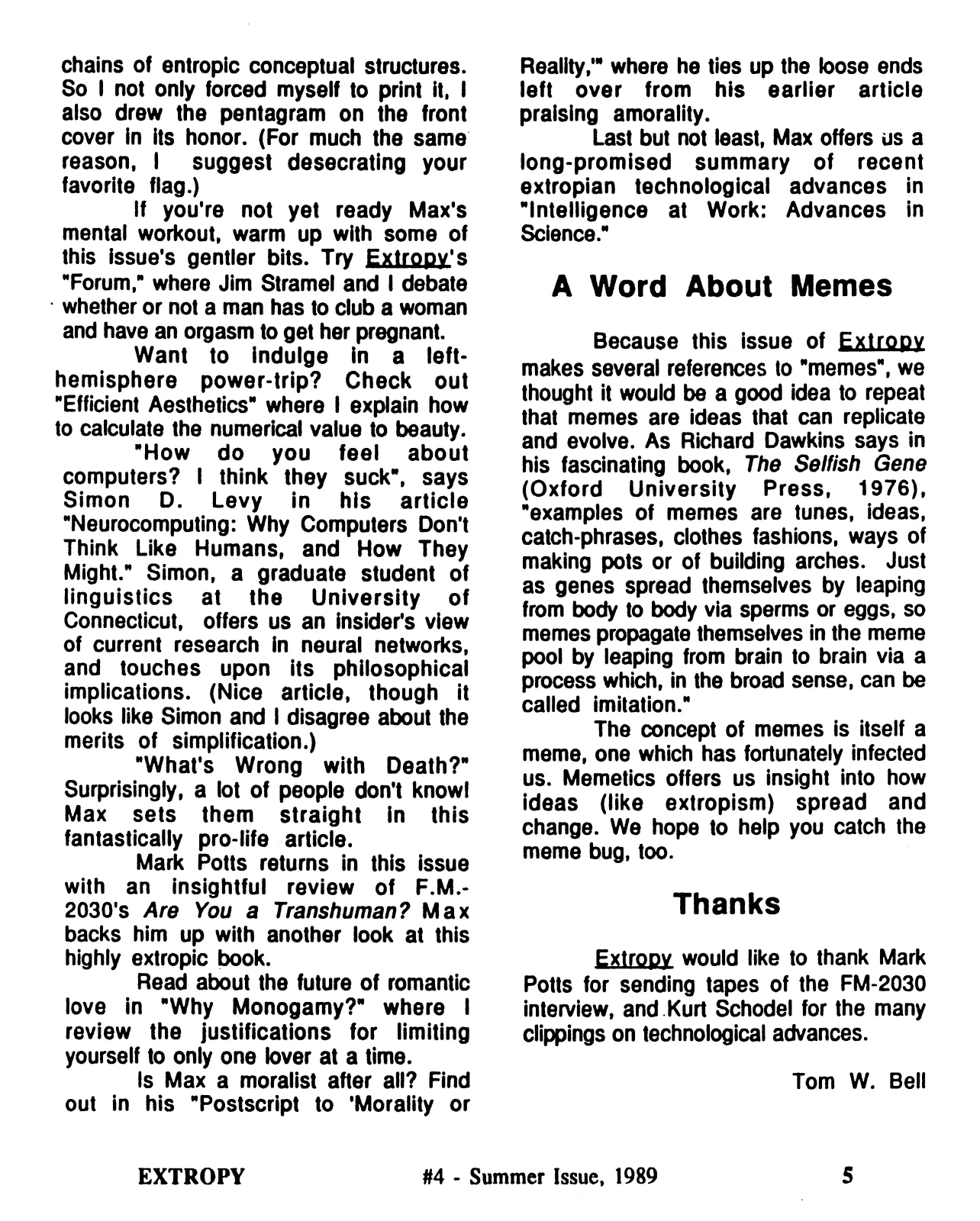
Because this issue of Extropy makes several references to ‘memes’, we thought it would be a good idea to repeat that memes are ideas that can replicate and evolve. As Richard Dawkins says in his fascinating book, The Selfish Gene (Oxford University Press, 1976), ‘examples of memes are tunes, ideas, catch-phrases, clothes fashions, ways of making pots or of building arches. Just as genes spread themselves by leaping from body to body via sperms or eggs, so memes propagate themselves in the meme pool by leaping from brain to brain via a process which, in the broad sense, can be called imitation.’
The concept of memes is itself a meme, one which has fortunately infected us. Memetics offers us insight into how ideas (like extropism) spread and change. We hope to help you catch the meme bug, too.
Thanks
Extropy would like to thank Mark Potts for sending tapes of the FM-2030 interview, and Kurt Schodel for the many clippings on technological advances.
Tom W. Bell
VIEW ORIGINAL SCAN (3 pages)